5 Best African Charities to Donate to in 2025 | African NGOs
Amigos Internacionales • June 2, 2025
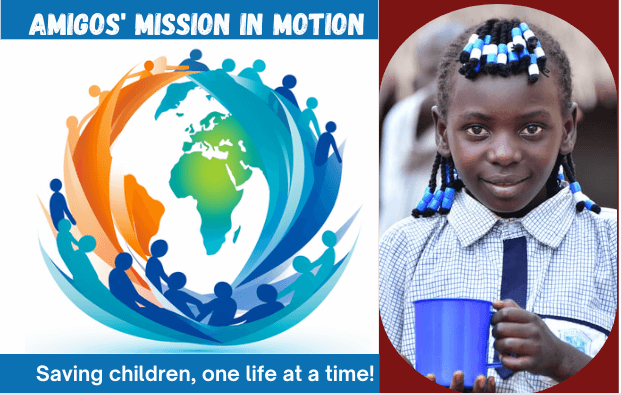
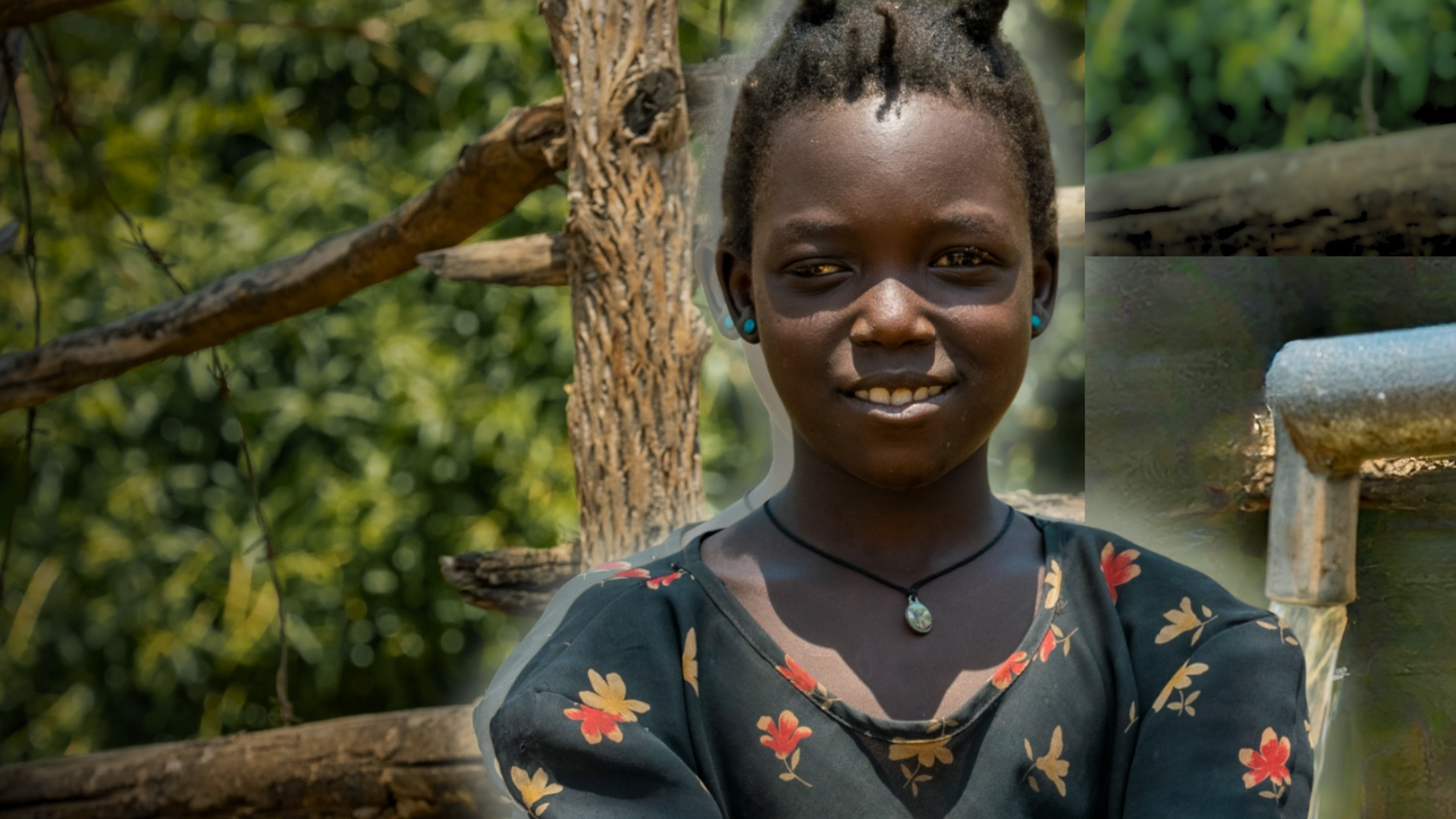
A poster for amigos mission in motion shows a girl holding a cup
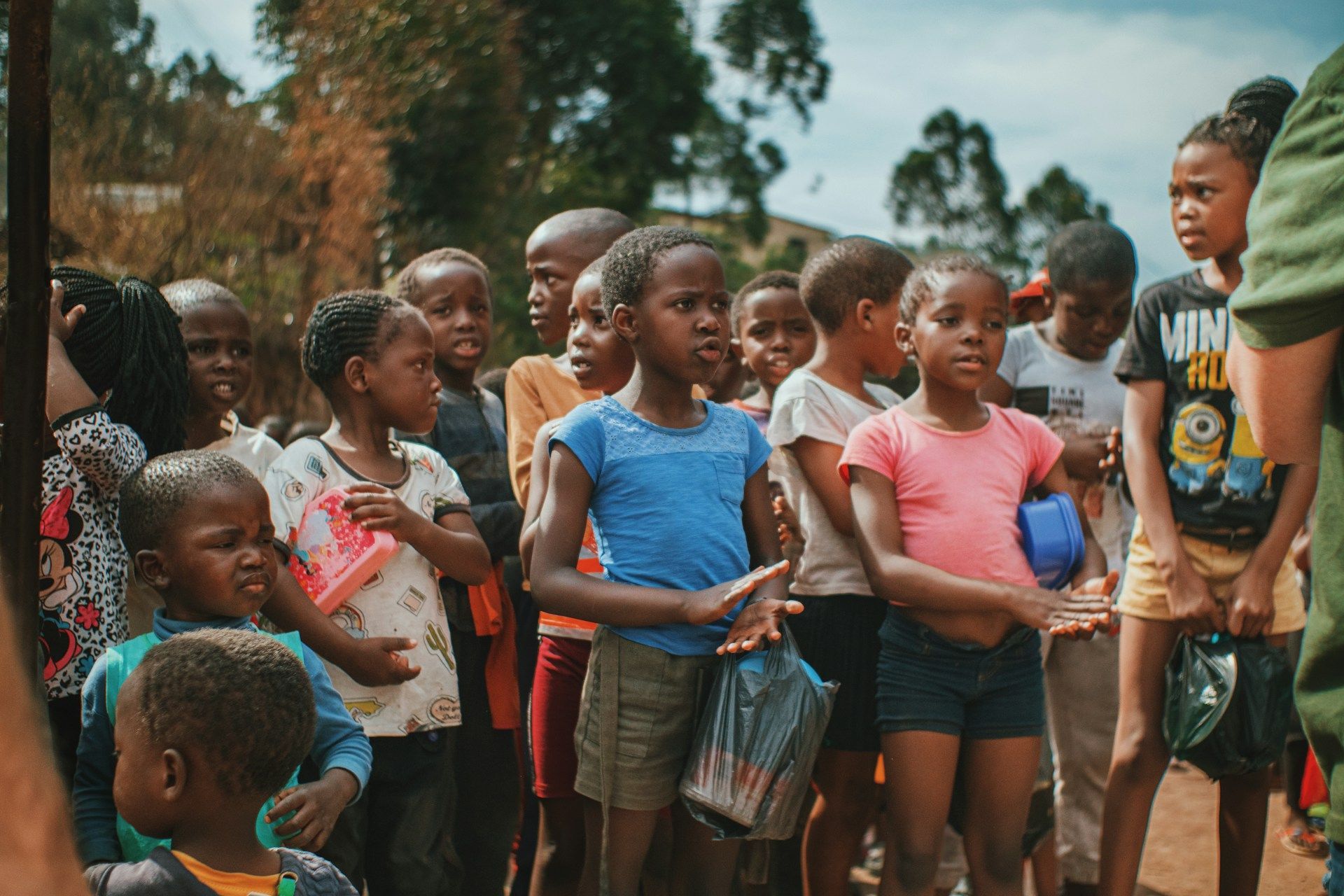
A group of children are standing in a line outside.

Africa’s vibrant cultures and boundless potential shine against immense challenges, poverty, hunger, and lack of clean water, affecting millions daily. Yet, dedicated charities transform lives, turning donations into hope, health, and opportunity. In 2025, your support can drive sustainable change across the continent. This blog highlights the best African charities to donate to, each making a profound impact through innovative, community-focused solutions.


>> Related Post:
  Countries with the Highest Poverty Rate in the World in 2025


Why Donate to African Charity Organizations?


Africa’s challenges are staggering: 490 million people live below the poverty line ($1.90/day), and 828 million globally face hunger, with Africa bearing a heavy burden. Malnutrition causes 45% of child deaths, and in regions like South Sudan, 60% lack access to clean water. Charities address these crises by providing food, healthcare, education, and sustainable solutions. Your donation fuels resilience, empowering communities to break free from poverty and thrive. Choosing reputable organizations ensures your gift creates a lasting impact.


>> Related Post:  5 Causes of Food Insecurity in 2025


What Makes a Charity Trustworthy?


The best African charities share key qualities: transparency, local engagement, and measurable impact. Look for charities with clear financial statements, low administrative costs, and community-driven solutions. Partnerships with local leaders and evidence-based programs ensure donations create lasting change.


>> Related Post:  Best Hunger Relief Charities to Donate to in 2025


Top 5 African Charities to Donate to in 2025


1. Amigos Internacionales


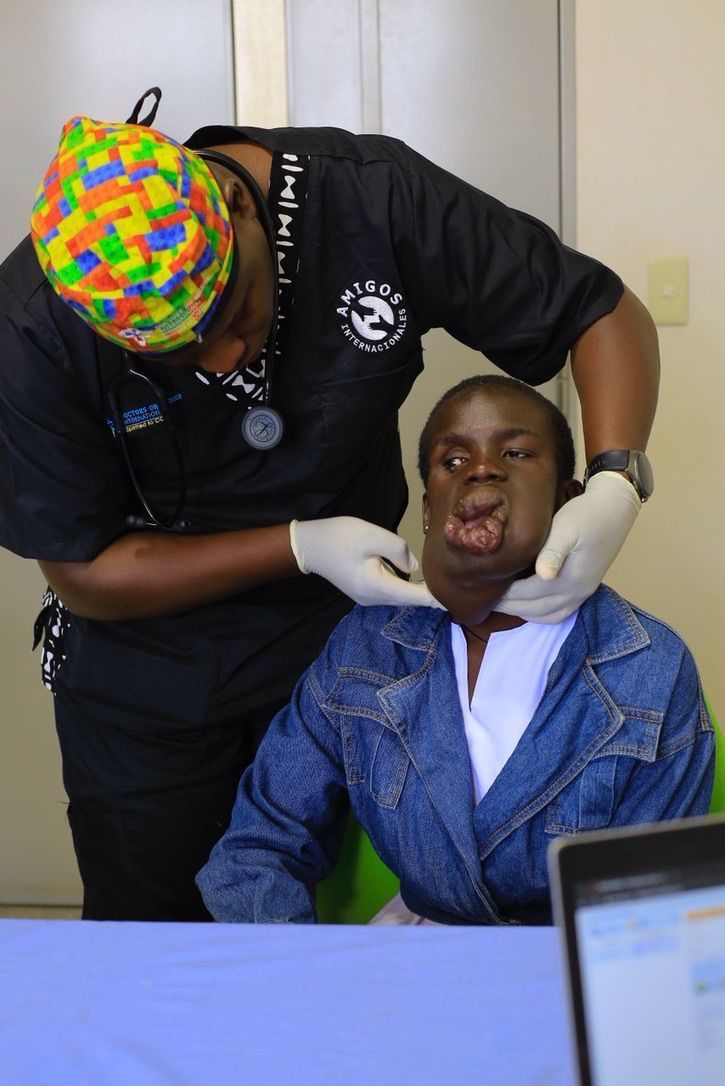
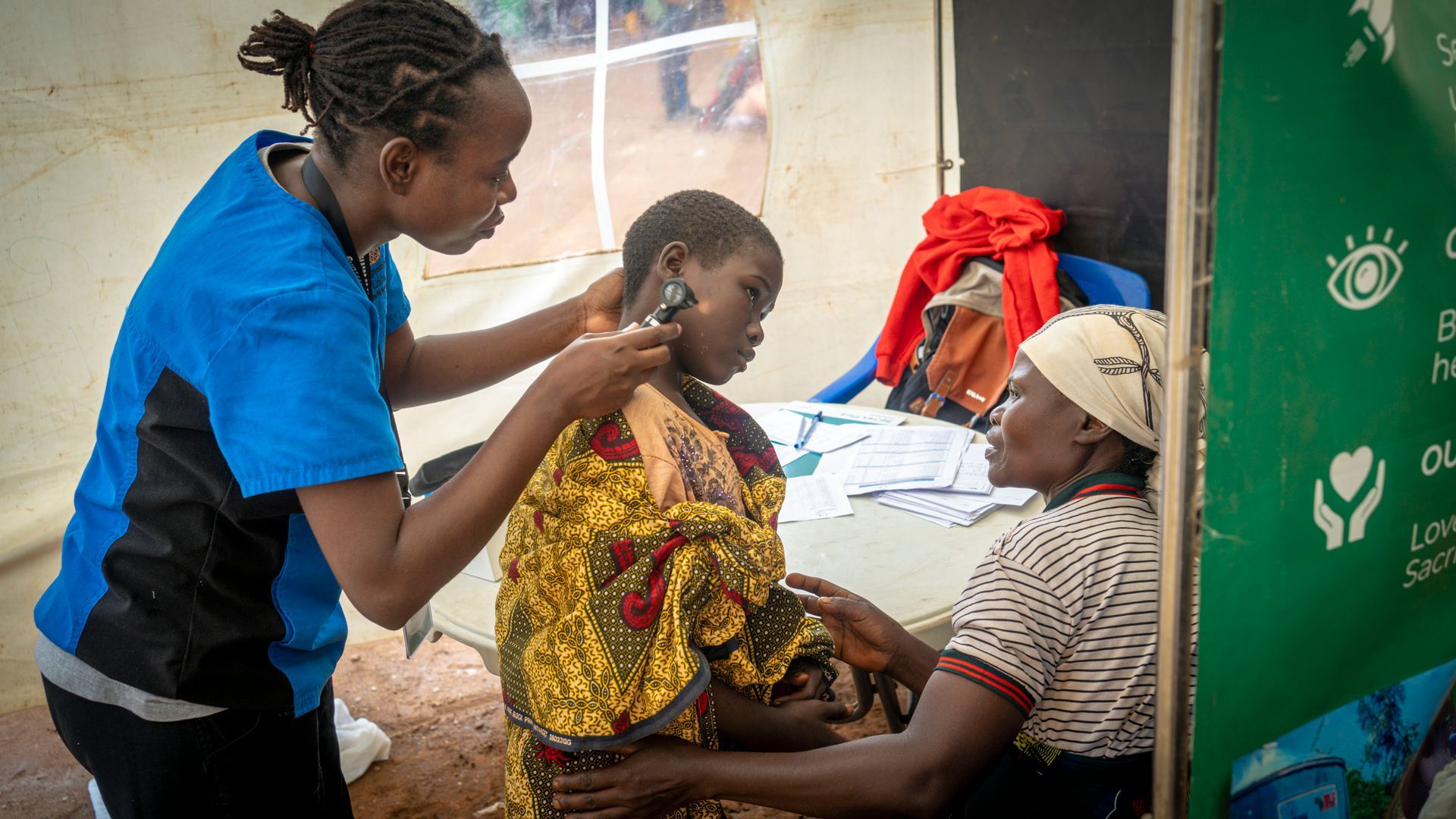
Amigos Internacionales is a beacon of hope, empowering rural African communities since 1967. Through its MissionPoint model in Uganda’s Ogul Village, Amigos provides over 7.5 million meals annually, feeding 21,000 children daily via programs like Karol’s Kitchen. It has built schools for 850+ students, drilled 10+ clean water wells to combat disease, and treated many patients in medical camps in March 2025. Amigos’ sustainable agriculture initiatives, like the Ogul Village Restoration Project, equip families with seeds and training to grow their own food, breaking the cycle of hunger.


2. ForAfrika


ForAfrika, founded in 1984, empowers 20 million Africans by 2032 with programs in Uganda, South Sudan, and more. In 2022, it provided 27.8 million school meals, installed 140 water wells, and treated 49,206 people for malnutrition. Its locally-led initiatives ensure sustainable impact in food security and healthcare.


3. Self Help Africa


Self Help Africa empowers rural farmers in sub-Saharan Africa with agricultural training and resources. By focusing on sustainable farming and gender equality, it helps communities grow enough food to feed families and earn income, lifting them out of poverty.


4. Bread and Water for Africa


This nonprofit supports health and education in Tanzania and Ethiopia, providing clean water, mosquito nets, and prenatal vitamins. In 2024, it helped orphans in Mwanza with meals and medical care, addressing acute hunger.


5. Action in Africa


Operating in Uganda, Action in Africa runs a community center in Nakuwadde, offering education, health, and food security programs. Its grassroots approach fosters local empowerment through events like its Winter Gala.


>> Related Post:
  Top 10 Poorest African Countries in 2025


Amigos Internacionales: Transforming Lives in Africa


One powerful example of charity in action is Amigos Internacionales, a nonprofit dedicated to building sustainable communities in rural Africa, particularly in Uganda. Amigos has created schools for over 850 children, drilled clean water wells to combat disease, and provided medical care through camps that treated 4,500 patients. By donating to Amigos, you’re not just giving money, you’re empowering entire communities with education, health, and faith, creating lasting change that you can feel proud to support.

  • $25 ensures meals for a Family for a Week.
  • $50 equips a Child with Essential Education Supplies for a year.
  • $100 empowers mothers to learn skills and support their families.


DONATE NOW


Conclusion


Africa’s challenges are immense, but charities like Amigos Internacionales are turning the tide with innovative, sustainable solutions. From feeding children daily to drilling life-saving water wells, Amigos leads the way in empowering communities. The organizations listed here offer diverse ways to make a difference, from education to healthcare. Your donation can build a brighter future, start with Amigos at amigosii.org and join the movement to transform Africa.


FAQs


  1. How can I verify a charity’s legitimacy?
    Check ratings on Charity Navigator or GuideStar, review financial reports, and ensure 501(c)(3) status for tax deductions. Amigos’ transparency is verified by its Platinum GuideStar rating.
  2. Can I donate goods instead of money?
    Many charities accept in-kind donations like school supplies or clothing.
  3. Can I volunteer with African charities?
    Yes, organizations like Amigos offer opportunities for volunteering in Uganda or Tanzania.
  4. Why focus on Africa-specific charities?
    Africa faces unique challenges like extreme poverty and conflict. Targeted charities ensure donations address local needs effectively, maximizing impact.
By Michael Ryer August 12, 2026
Quick answer: You can help rebuild a school and community in Nwoya District, northern Uganda, by giving to Korobar MissionPoint at amigosii.org/?give=PYEVM6DX . A gift of any size helps; $12,500 is the working target to fully repair, equip, and stabilize Orua Community Nursery and Primary School, and $1,215/month sustains it going forward. Every figure below is itemized and sourced in Part 5 of this series. Everything else in this article explains why that gift matters and to whom. What happened in northern Uganda, in three sentences
By Michael Ryer August 12, 2026
If Part 5 left you with one number, it was probably $12,500 — the working target to repair, equip, and stabilize Orua Community Nursery and Primary School. That number is real, and it matters. It's also, on its own, an incomplete picture of what Amigos Internacionales is actually trying to build in Korobar. A school, by itself, can only do so much. Children who are sick miss class. Families without clean water spend hours a day on a chore that could be minutes. A community without local pastoral leadership eventually finds its momentum depends entirely on outsiders showing up, rather than on people who live there. Amigos calls its answer to that problem a MissionPoint — and it's worth explaining plainly what that actually means, rather than letting the word do vague, inspirational work on its own.
By Michael Ryer August 12, 2026
There's a number a lot of nonprofit fundraising pages love: a big, round figure — "$50,000 builds a school!" — that's easy to print on a banner and hard to actually verify. This article is the opposite of that. Part 4 of this series told the story of Orua Community Nursery and Primary School — a school parents built themselves, that nearly collapsed when payroll failed. This part answers the question every serious donor eventually asks: what does it actually cost to fix, and how do we know? The figures below come from one source: Patrick Kibwota's June 2026 site assessment, conducted after Amigos Internacionales was invited into Korobar. They are working estimates, not final audited numbers, and this article says so at every point where that distinction matters — because a transparent budget that admits its own limits is more trustworthy than a tidy one that doesn't. New to this story? Part 4 tells how Orua Community Nursery and Primary School got here. Repair, not rebuild — and why that matters financially
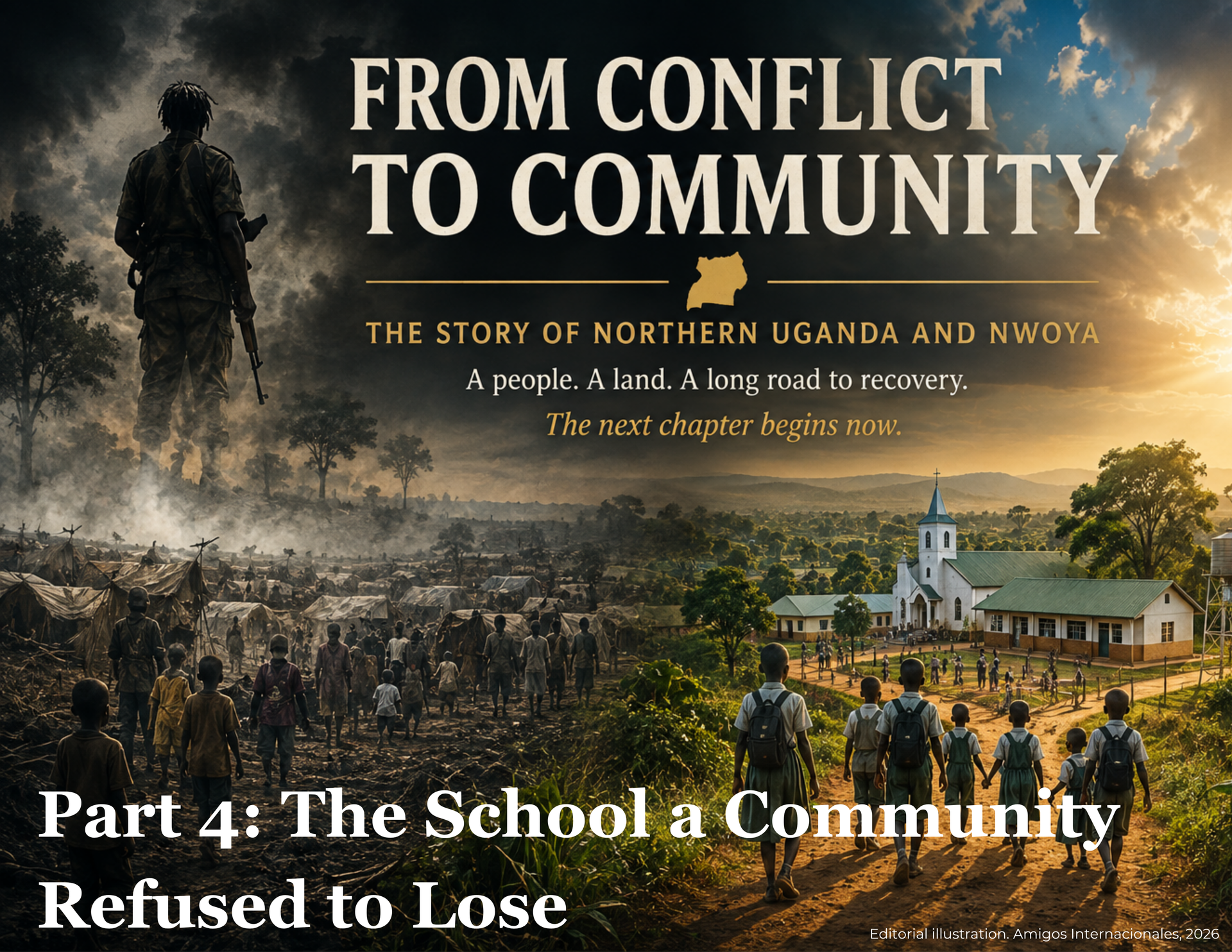
From Conflict to Community series illustration — Part 4: The School a Community Refused to Lose
By Michael Ryer August 10, 2026
Before Amigos arrived, this community already built its own school. Here's the story of Orua Community Nursery and Primary School in Nwoya, Uganda.
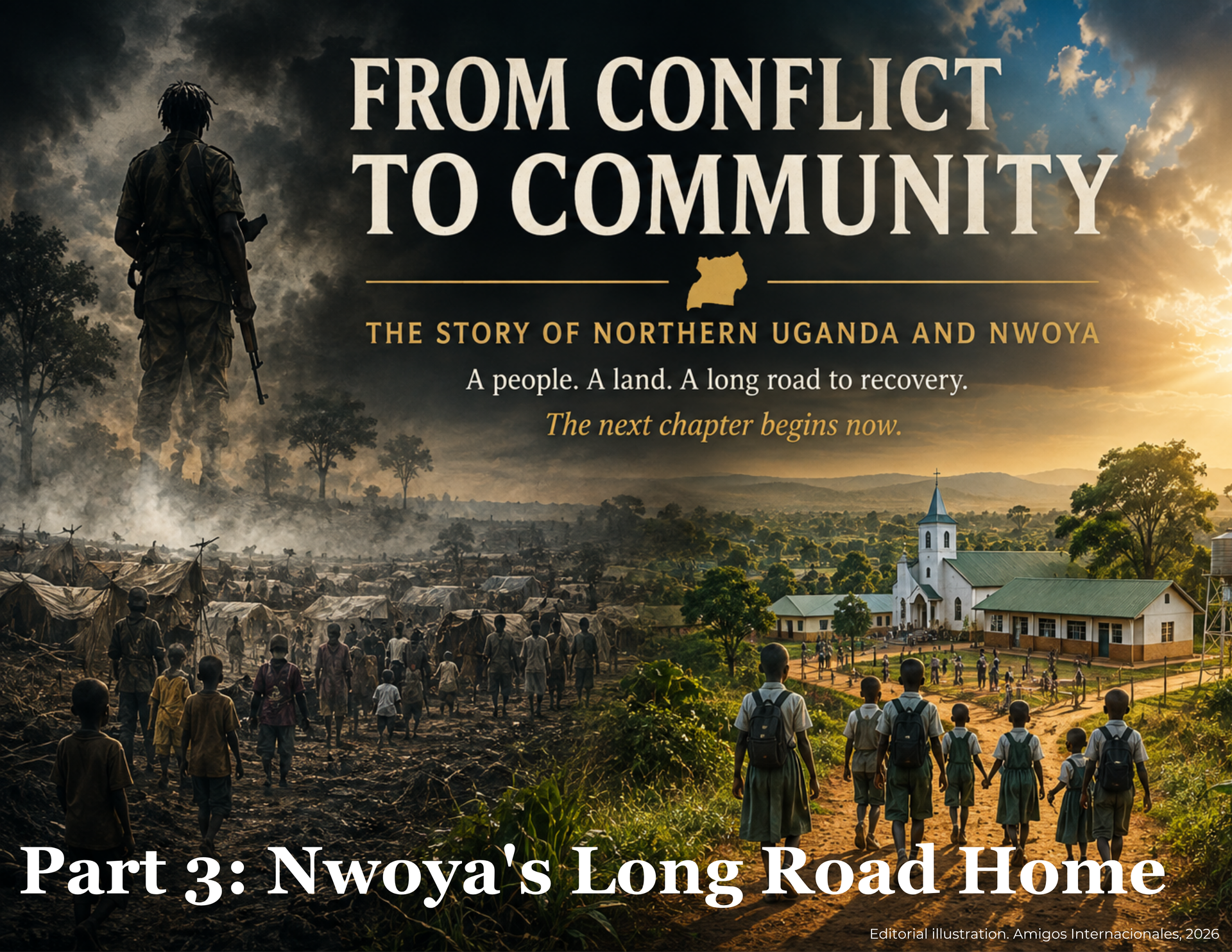
From Conflict to Community series illustration — Part 3: Nwoya's Long Road Home
By Michael Ryer August 10, 2026
From displacement camps to a growing district with its own economy — the story of how Nwoya, Uganda came home, and what it's still building.
By Michael Ryer August 5, 2026
Ask someone who grew up in Gulu District in the early 2000s what they remember most, and you won't always hear about an attack. You'll often hear about a walk. Every evening, as the light started to go, children left their homes — or their family's space inside a displacement camp — and walked toward the nearest town center. Not to visit anyone. To sleep somewhere the Lord's Resistance Army was less likely to find them. In the morning, they walked home again, went to whatever school was still functioning, and did it all again the next evening. Aid workers and journalists came to call them "night commuters," and for a few years in the middle of the war, they were one of the most visible symptoms of what the conflict was actually doing to an entire generation.
By Michael Ryer August 4, 2026
How the Lord's Resistance Army shaped Nwoya, Uganda — and how communities are rebuilding schools and futures nearly 20 years after the war ended.
By Michael Ryer July 19, 2026
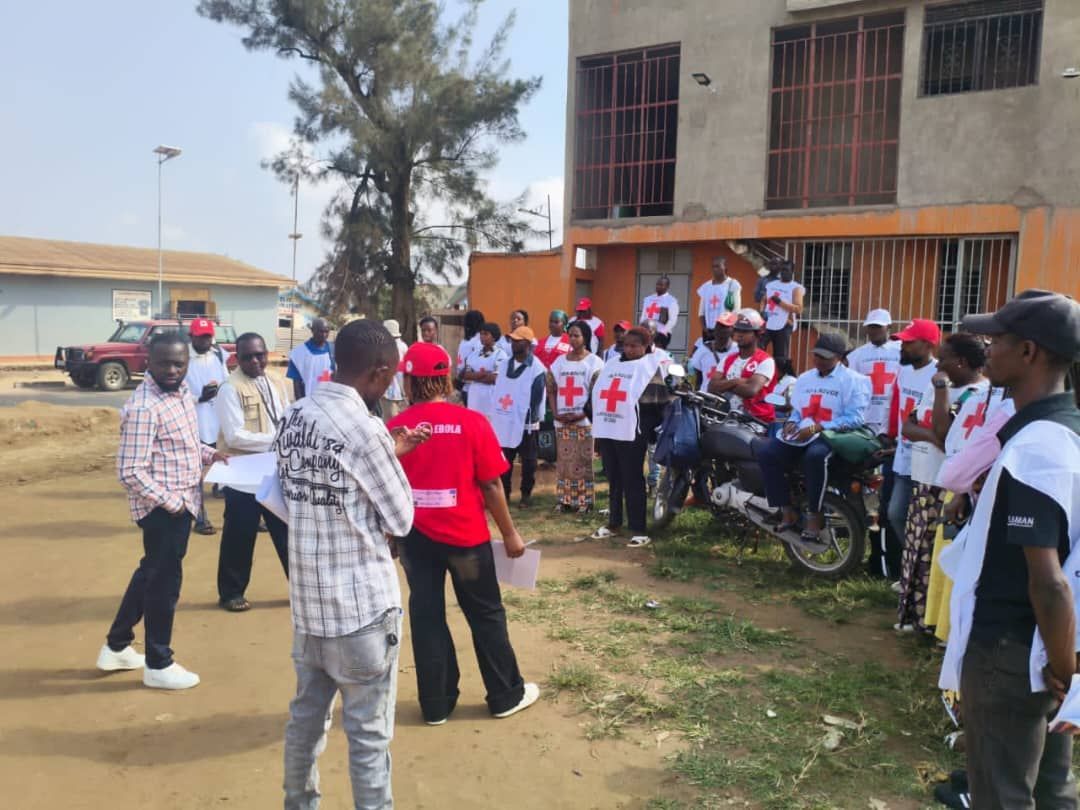
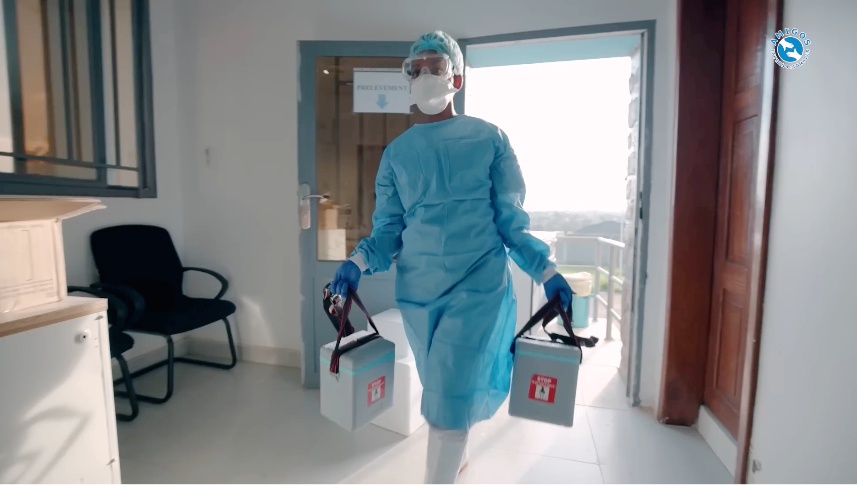
Learn how Amigos Internacionales and local health leaders are strengthening Ebola community surveillance, risk communication, and early detection across eastern Democratic Republic of Congo.
Ebola response reports
By Paul Mulyamboga July 16, 2026
Read real-time field notes from Dr. Paul Mulyamboga, Director of Medical Services for Amigos Internacionales, serving on the front lines of the Ebola outbreak in eastern Democratic Republic of Congo.
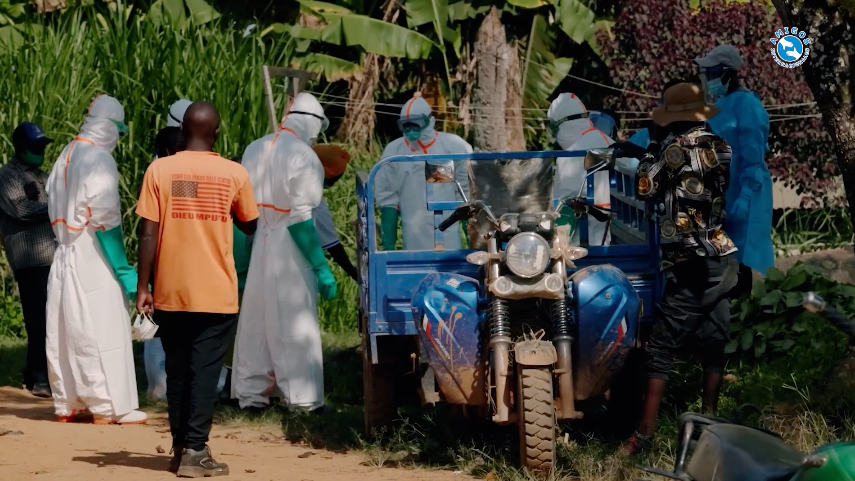
Medical teams respond to the Ebola outbreak in eastern Democratic Republic of the Congo through surv
By Michael Ryer July 3, 2026
Learn how Ebola spreads, why eastern Congo faces repeated outbreaks, and how Amigos Internacionales and Doctors on Mission International are strengthening healthcare systems.
By Michael Ryer June 9, 2026
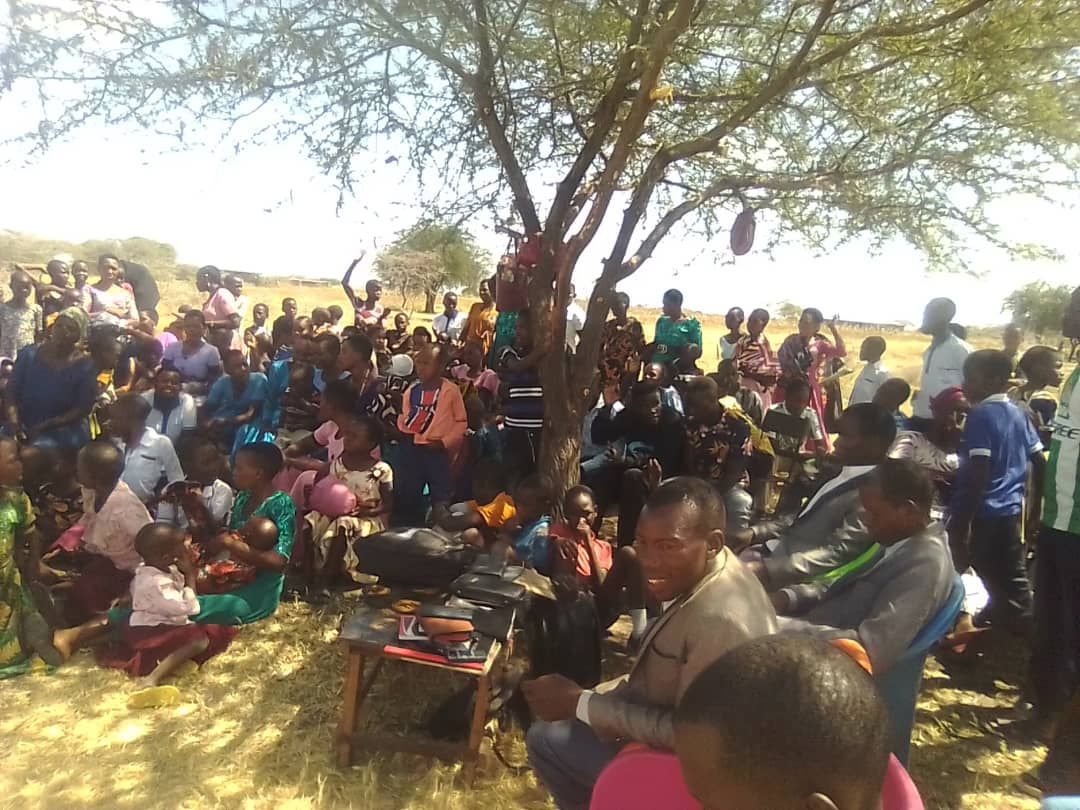
A Pentecost outreach by Pastor Abogasti became the founding of Mwakalundi Baptist Church — 80 baptized believers, first worship under a tree, in Tanzania.
By Victor Phiri June 1, 2026
More Posts

Social Media

By Michael Ryer August 12, 2026
Quick answer: You can help rebuild a school and community in Nwoya District, northern Uganda, by giving to Korobar MissionPoint at amigosii.org/?give=PYEVM6DX . A gift of any size helps; $12,500 is the working target to fully repair, equip, and stabilize Orua Community Nursery and Primary School, and $1,215/month sustains it going forward. Every figure below is itemized and sourced in Part 5 of this series. Everything else in this article explains why that gift matters and to whom. What happened in northern Uganda, in three sentences
By Michael Ryer August 12, 2026
If Part 5 left you with one number, it was probably $12,500 — the working target to repair, equip, and stabilize Orua Community Nursery and Primary School. That number is real, and it matters. It's also, on its own, an incomplete picture of what Amigos Internacionales is actually trying to build in Korobar. A school, by itself, can only do so much. Children who are sick miss class. Families without clean water spend hours a day on a chore that could be minutes. A community without local pastoral leadership eventually finds its momentum depends entirely on outsiders showing up, rather than on people who live there. Amigos calls its answer to that problem a MissionPoint — and it's worth explaining plainly what that actually means, rather than letting the word do vague, inspirational work on its own.
By Michael Ryer August 12, 2026
There's a number a lot of nonprofit fundraising pages love: a big, round figure — "$50,000 builds a school!" — that's easy to print on a banner and hard to actually verify. This article is the opposite of that. Part 4 of this series told the story of Orua Community Nursery and Primary School — a school parents built themselves, that nearly collapsed when payroll failed. This part answers the question every serious donor eventually asks: what does it actually cost to fix, and how do we know? The figures below come from one source: Patrick Kibwota's June 2026 site assessment, conducted after Amigos Internacionales was invited into Korobar. They are working estimates, not final audited numbers, and this article says so at every point where that distinction matters — because a transparent budget that admits its own limits is more trustworthy than a tidy one that doesn't. New to this story? Part 4 tells how Orua Community Nursery and Primary School got here. Repair, not rebuild — and why that matters financially
From Conflict to Community series illustration — Part 4: The School a Community Refused to Lose
By Michael Ryer August 10, 2026
Before Amigos arrived, this community already built its own school. Here's the story of Orua Community Nursery and Primary School in Nwoya, Uganda.
From Conflict to Community series illustration — Part 3: Nwoya's Long Road Home
By Michael Ryer August 10, 2026
From displacement camps to a growing district with its own economy — the story of how Nwoya, Uganda came home, and what it's still building.
By Michael Ryer August 5, 2026
Ask someone who grew up in Gulu District in the early 2000s what they remember most, and you won't always hear about an attack. You'll often hear about a walk. Every evening, as the light started to go, children left their homes — or their family's space inside a displacement camp — and walked toward the nearest town center. Not to visit anyone. To sleep somewhere the Lord's Resistance Army was less likely to find them. In the morning, they walked home again, went to whatever school was still functioning, and did it all again the next evening. Aid workers and journalists came to call them "night commuters," and for a few years in the middle of the war, they were one of the most visible symptoms of what the conflict was actually doing to an entire generation.
By Michael Ryer August 4, 2026
How the Lord's Resistance Army shaped Nwoya, Uganda — and how communities are rebuilding schools and futures nearly 20 years after the war ended.
By Michael Ryer July 19, 2026
Learn how Amigos Internacionales and local health leaders are strengthening Ebola community surveillance, risk communication, and early detection across eastern Democratic Republic of Congo.
Ebola response reports
By Paul Mulyamboga July 16, 2026
Read real-time field notes from Dr. Paul Mulyamboga, Director of Medical Services for Amigos Internacionales, serving on the front lines of the Ebola outbreak in eastern Democratic Republic of Congo.
Medical teams respond to the Ebola outbreak in eastern Democratic Republic of the Congo through surv
By Michael Ryer July 3, 2026
Learn how Ebola spreads, why eastern Congo faces repeated outbreaks, and how Amigos Internacionales and Doctors on Mission International are strengthening healthcare systems.
By Michael Ryer June 9, 2026
A Pentecost outreach by Pastor Abogasti became the founding of Mwakalundi Baptist Church — 80 baptized believers, first worship under a tree, in Tanzania.
By Victor Phiri June 1, 2026
By Warren Olgado May 25, 2026
In a small rural village in Tanzania, a man sits quietly outside his home. His body is thin. His shoulders are tired. And rising from his back is a painful tumor that has slowly stolen nearly everything from him. His name is Zakaria. For years, Zakaria worked as a boda boda driver, carrying passengers from village to village on his motorcycle. In East Africa, a boda boda is more than transportation. For many families, it is survival. Every ride meant food. Every mile meant provision. Every long day on rough roads meant another opportunity to care for his wife and continue moving forward. But suffering often enters quietly. What began as a hitching pain in Zakaria’s back slowly became swelling. At first, it was manageable. Like many men trying to provide for their families, he pushed through the discomfort and kept working. But the pain continued. The swelling grew. And over time, the tumor became impossible to ignore. Today, Zakaria lives with constant pain and uncertainty. The disease has robbed him of strength, dignity, income, and peace. The motorcycle he once depended on has already been sold in a desperate attempt to find healing. And yet, in the middle of suffering, something unexpected happened. Hope arrived.
By Michael Ryer May 20, 2026
In many parts of the world, turning on a faucet is so ordinary that it barely deserves a second thought. A glass fills. A child drinks. A mother does the dishes. A shower runs before work or school. Clean water is simply there. In Northern Uganda, that reality still feels distant for thousands of families. In many villages scattered across rural East Africa, water is not found in a kitchen sink or flowing from pipes beneath the ground. It is carried in yellow jerrycans across dusty roads and narrow footpaths. It is gathered from muddy ponds, shallow holes carved into the earth, or stagnant pools shared with livestock. Sometimes it is brown. Sometimes it smells foul. Sometimes it makes children sick. For families with no other option, it is all they have. The water crisis in East Africa is not only about thirst. It affects health, education, safety, opportunity, and dignity. It shapes how children spend their mornings and how mothers spend their days. It determines whether girls attend school consistently or remain trapped in long daily walks carrying heavy containers of water under the scorching sun. At Amigos Internacionales, this reality is not theoretical. Staff and partners have sat beside families in remote villages. They have watched children scoop water from contaminated pits after rainfall. They have seen entire communities transformed when clean water finally arrived. That transformation is why water remains one of the most urgent and powerful parts of the MissionPoint model across Northern Uganda.
By Michael Ryer May 13, 2026
For seventeen years, Bridgette has carried a burden no child should ever bear. What started as a small red spot on her face when she was just a baby grew into a massive vascular tumor that doctors across Uganda refused to operate on. Too risky, they said. The tumor could bleed too much. She might not survive. Come back when she's older. Come back when it's smaller. Come back, come back, come back. Bridgette and her mother, Rose, heard "no" for seventeen years. But today, something has finally changed. Bridgette is now on medication that is actively shrinking her tumor. Dr. Paul Mulyamboga, Amigos Internacionales' Director of Medical Services and founder of Doctors on Mission, is monitoring her progress. When the tumor reaches an operable size, he will refer her to Mulago National Referral Hospital in Kampala for the vascular surgery that could change her life. There's just one problem: surgery can only happen if the funding is already in place . If we don't raise $12,000 before Bridgette's tumor is ready for surgery, she will have to wait again. And after seventeen years of waiting, we cannot let that happen. How It Started — A Small Red Spot
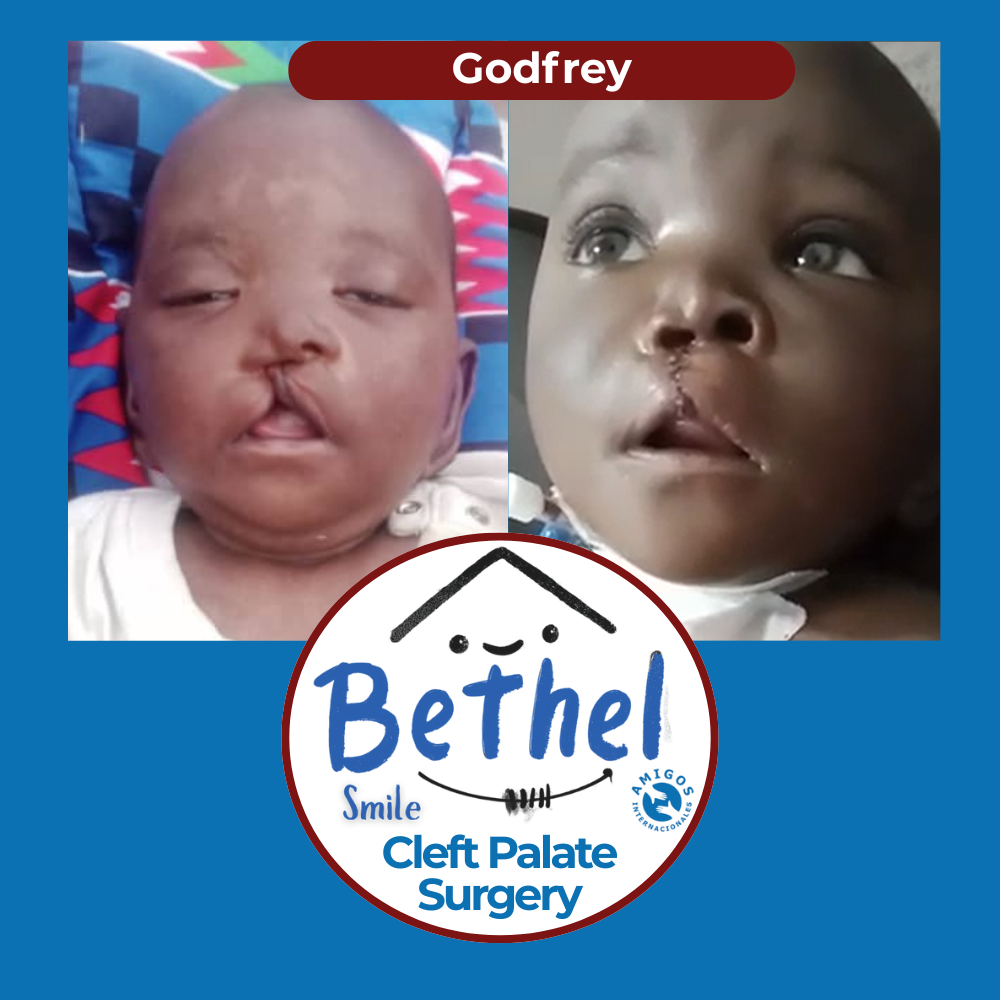
Rwottwero Godfrey before and after cleft lip surgery — Bethel Smile program, Amigos Internacionales
By Amigos Internacionales April 30, 2026
Baby Godfrey couldn't eat without pain. His family couldn't afford surgery. The Bethel Smile program gave him free cleft lip surgery at 4 months old.
MissionPoint Burundi free medical camp in Gisuru, doctors treating patients
By Amigos Internacionales April 28, 2026
Inside the Gisuru medical camp in Burundi — surgeries, eye care, and spiritual ministry delivered by volunteer doctors. See the full impact report from 2025.
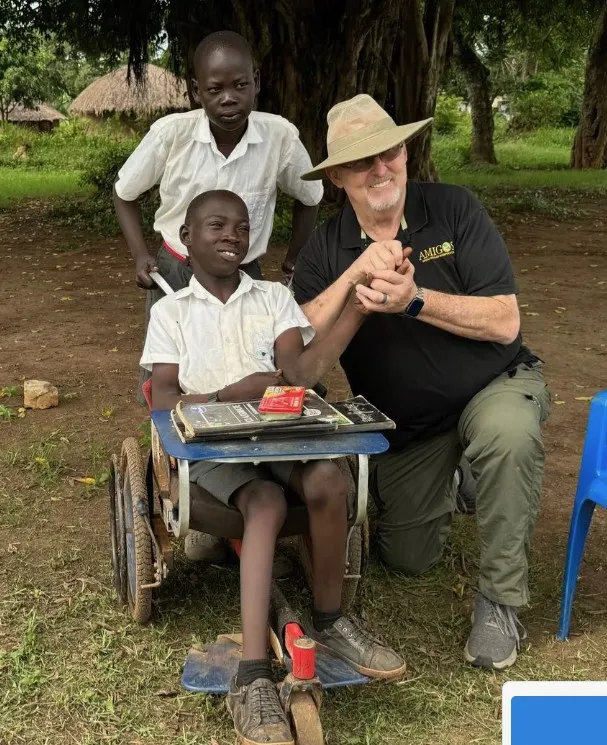
Two people beside a wheelchair outside, with a child seated at a small desk in a grassy outdoor area.
By Amigos Internacionales April 27, 2026
East Texas journalist Jennifer Scott traveled to East Africa to cover Amigos Internacionales. Read the full Tyler Morning Telegraph feature from April 2026.
By Amigos Internacionales April 13, 2026
Learn how church missions in Africa, through partnerships with Amigos Internacionales, can bring lasting change to communities in need. Get involved in education, healthcare, and development projects.
By Amigos Internacionales April 9, 2026
Discover the resilience of refugees in Northern Uganda and how Amigos Internacionales is providing medical care, education, and empowerment to help rebuild lives.
Show More